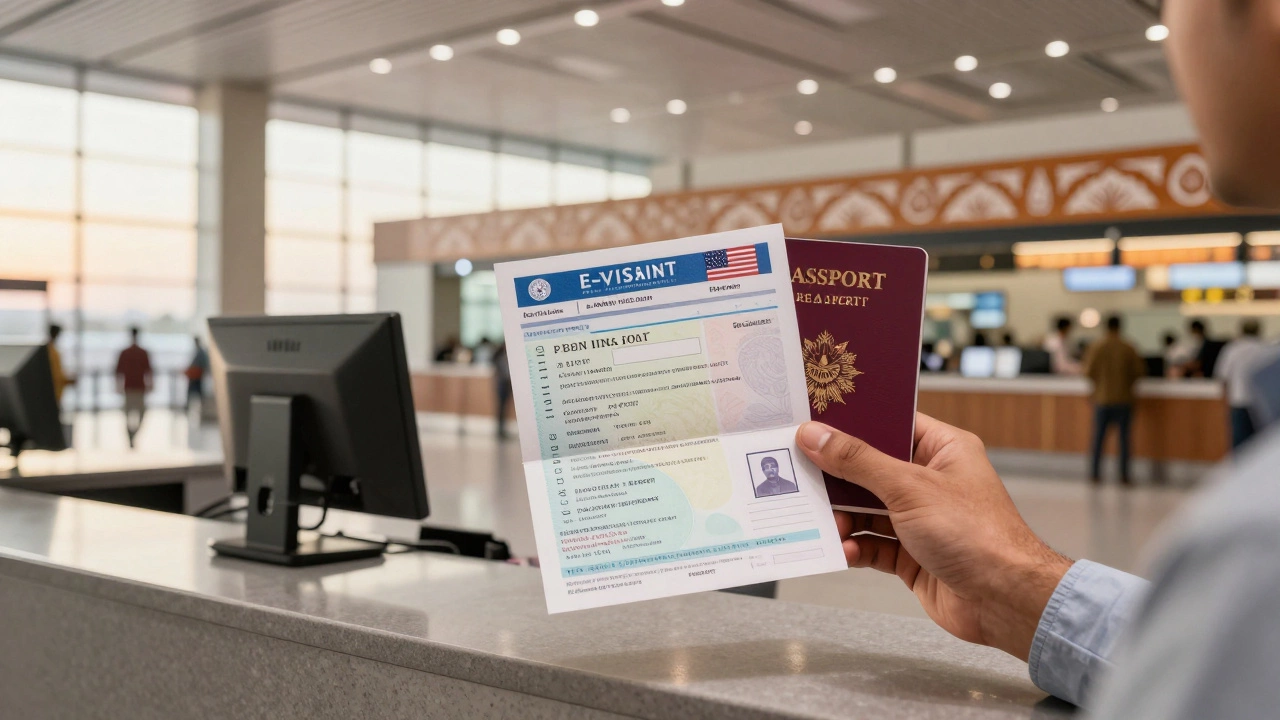
Indian Visa Cost Calculator
Calculate your total Indian visa costs based on the options you choose.
Select Your Visa Option
Valid for 10 years, allows multiple entries, up to 180 days per visit
Valid for 6 months, allows multiple entries, up to 180 days total
Add Optional Services
Optional fee for fingerprint collection at visa center
For urgent applications (24-hour processing)
Recommended coverage for medical emergencies
If you're planning a trip to India as a US citizen, one of the first things you’ll need to figure out is the visa cost. It’s not just about the price tag-it’s about knowing exactly what you’re paying for, how long it lasts, and whether you’re getting the right type of visa for your trip. The good news? Getting an Indian visa is straightforward. The tricky part? Making sure you don’t overpay or get stuck with the wrong option.
What’s the current cost of an Indian tourist visa for US citizens?
As of December 2025, the standard Indian tourist visa for US citizens costs $160 for a 10-year multiple-entry visa. That’s the most common choice for travelers who plan to visit India more than once, or who want flexibility in their travel dates. This visa lets you stay in India for up to 180 days per visit, and you can enter and leave the country as many times as you want over the next decade.
There’s also a shorter-term option: the 6-month tourist visa. It costs $80 and allows multiple entries, but you can only stay up to 180 days total during that six-month window. Most travelers don’t pick this one unless they’re planning a single long trip and don’t need the visa to last longer than half a year.
These fees are set by the Indian government and are the same whether you apply online or through a consulate. There’s no discount for students, seniors, or families. Everyone pays the same rate.
What’s included in the visa fee?
The $160 fee covers everything: application processing, biometric data collection (fingerprints and photo), and the visa itself. You won’t be charged extra for the e-Visa portal, courier service, or customer support. That’s different from some other countries where hidden fees pile up.
Here’s what you’re actually paying for:
- Online application processing through the Indian government’s official portal
- Secure digital visa issuance (no paper stamp needed)
- Biometric verification at the visa application center
- 10-year validity with multiple entries
- Access to 30+ Indian airports and seaports for entry
There’s no service fee if you apply directly through the official website. But if you use a third-party agency-like a travel agent or visa expediting service-they might charge you $50 to $150 extra to handle the paperwork for you. You don’t need them. The process is simple enough to do yourself.
How to apply for your Indian visa (step by step)
Applying for an Indian visa is all done online. You don’t need to visit an embassy unless something goes wrong. Here’s how it works:
- Go to the official Indian e-Visa portal: indianvisaonline.gov.in
- Create an account with your email and a strong password
- Fill out the application form with your passport details, travel plans, and personal info
- Upload a passport-style photo (white background, no glasses)
- Upload a scanned copy of your passport’s bio page
- Pay the $160 fee with a credit or debit card
- Wait 2 to 4 business days for approval
- Download and print your e-Visa (you’ll need it at check-in and immigration)
You’ll get an email with your visa attached as a PDF. Print two copies-one for your luggage, one for your wallet. You don’t need to carry your passport with the visa stamped in it. The digital version is legally valid.
What about the e-Tourist Visa? Is it cheaper?
Yes, and no. India offers an e-Tourist Visa that used to be cheaper, but as of 2025, the pricing has been aligned with the regular tourist visa. The e-Tourist Visa is now the same $160 fee and same 10-year validity. The only difference is that the e-Tourist Visa is processed faster-usually within 72 hours-and can only be applied for online. There’s no paper version.
Before 2023, the e-Tourist Visa cost $60 and was limited to 60 days per visit. That option is gone. Now, the e-Tourist Visa is just the digital version of the standard 10-year visa. Don’t fall for old blog posts saying you can get a cheap 30-day visa. Those are outdated.
Are there any extra costs?
Yes-but they’re optional. The visa fee itself is fixed. But here are places where you might spend more:
- Biometric appointment fees: If you’re applying from outside the US, some visa centers charge $20-$30 to collect fingerprints. In the US, this is free at designated centers like VFS Global offices.
- Expedited processing: The government doesn’t offer rush service. If you need your visa in 24 hours, you’ll have to pay a private company to handle it for you-usually $150+ extra.
- Travel insurance: Not required, but smart. Most US travelers buy it for $50-$100 to cover medical emergencies, lost luggage, or trip cancellations.
- COVID-19 tests or vaccines: Not required anymore. India dropped all health entry rules in 2023.
Stick to the official website. No one needs to pay extra for a visa they can get themselves.
What if you’re visiting for business, medical treatment, or volunteering?
The $160 tourist visa won’t work for those trips. Here’s what you need instead:
- Business visa: $160 (same price) but requires a letter from your Indian host company and proof of business purpose. Valid for 1-5 years.
- Medical visa: $160, plus a letter from an Indian hospital confirming your appointment. You can bring up to two attendants on the same visa.
- Volunteer visa: Not available. You must apply for a tourist visa and prove your volunteer work is unpaid and short-term (under 90 days).
If you’re going to India to teach, work, or live long-term, you’ll need a different visa type entirely-like an employment visa or student visa. Those cost more and require interviews.
What documents do you need besides the visa?
Your passport must be valid for at least six months beyond your planned departure from India. It also needs at least two blank pages for immigration stamps-even though you have an e-Visa, officers still stamp your passport on arrival.
You should also have:
- A confirmed return or onward flight ticket
- Proof of accommodation (hotel booking or host address)
- Proof of sufficient funds-around $50 per day is the unofficial guideline
Immigration officers rarely ask for these, but they have the right to. Keep them handy on your phone or in print.
Common mistakes US travelers make
Here’s what goes wrong-and how to avoid it:
- Applying too late: Don’t wait until the week before your trip. Even though it takes 2-4 days, delays happen. Apply at least two weeks ahead.
- Using unofficial sites: Watch out for sites like "indianvisa.com" or "visa4india.org"-they’re not official. They charge more and sometimes steal your data.
- Forgetting to print the visa: Some airlines won’t let you board without a printed copy of your e-Visa.
- Using the wrong passport: If you renewed your passport after applying, your visa is invalid. You’ll need to reapply.
- Assuming it’s valid for all of India: The visa works everywhere except protected areas like parts of Arunachal Pradesh, some parts of Jammu & Kashmir, and the Andaman & Nicobar Islands. You need a special permit for those.
Is the Indian visa worth it?
At $160 for 10 years, the Indian visa is one of the best travel deals out there. Think about it: that’s less than $16 per year. If you visit India even twice in the next decade, you’ve already paid for your visa twice over.
Compare that to a Schengen visa ($80 for 90 days) or a UK visa ($140 for 6 months). India gives you a decade of access for a price that’s hard to beat.
And if you’re planning a backpacking trip, a spiritual retreat in Rishikesh, or a luxury train journey across Rajasthan-you’re not just buying a visa. You’re buying access to one of the most diverse, vibrant, and unforgettable countries on Earth.
Frequently Asked Questions
Can I get a visa on arrival in India as a US citizen?
No. India does not offer visas on arrival for US citizens. You must apply online before you travel. Arriving without a visa will result in being denied entry.
How long does it take to get an Indian visa after applying?
Most applications are approved within 2 to 4 business days. If you apply on a Friday, don’t expect approval until Tuesday. Weekends and Indian holidays delay processing. Apply at least two weeks before your trip.
Can I extend my Indian tourist visa while I’m in India?
No. Tourist visas cannot be extended. If you want to stay longer, you must leave India and reapply from outside the country. Overstaying can result in fines, deportation, or a ban from re-entering.
Do children need a visa to visit India?
Yes. Every US citizen, including infants and toddlers, needs their own visa. You apply for them the same way-with their own passport and photo. The fee is the same: $160 per child.
Is the Indian visa valid for visiting Leh or Ladakh?
Yes, the standard tourist visa covers Leh and Ladakh. However, if you plan to visit restricted areas like the Line of Control or certain border zones, you’ll need a Protected Area Permit (PAP), which you can get locally in Leh. The visa itself doesn’t restrict you from going to Ladakh.
What if my visa application is rejected?
If your application is rejected, you’ll get an email explaining why. Common reasons: blurry photo, mismatched passport info, or incomplete form. You can reapply immediately with corrected details. There’s no refund for rejected applications.
Can I use my Indian visa if I change my name?
No. If you’ve legally changed your name-through marriage, court order, or other means-you must apply for a new visa under your updated name. Your old visa will be invalid, even if it’s still within its 10-year window.
Is there a limit to how many times I can enter India on a 10-year visa?
No. You can enter India as many times as you want during the 10-year validity. Just make sure you don’t stay more than 180 days in a single visit. There’s no rule about how long you must wait between visits.